Aged R-Value (Long-Term Thermal Resistance or LTTR)
Extruded Polystyrene Rigid Foam Insulation products (XPS) have a closed cellular structure and are manufactured with a blowing agent specifically selected for its ability to facilitate the XPS extrusion manufacturing process which enhances the thermal performance of the foam insulation.
Over a long period of time (50 to 75 years), the blowing agent slowly diffuses through the thickness of the foam, and air slowly diffuses into the closed cellular structure replacing the blowing agent. The result of this gas movement is a slight change in the overall thermal resistance (R-value) of the XPS insulation over time. This phenomenon is typically called “aging” and results in an LTTR value.
Accurately identifying the aged (LTTR) R-value of XPS is important for a variety of reasons:
- Designers need accurate thermal resistance data to determine the heating and cooling loads for homes and commercial buildings.
- Insulation products are compared to one another based on thermal performance and other performance criteria.
CAN/ULC S770
The Canadian standard, CAN/ULC S770-03, predicts the long-term thermal resistance (LTTR) of foam insulation products as the 5-year R-value after aging in a laboratory environment. LTTR is a property which may be used to compare thermal performance characteristics of different foam insulation products to one another.
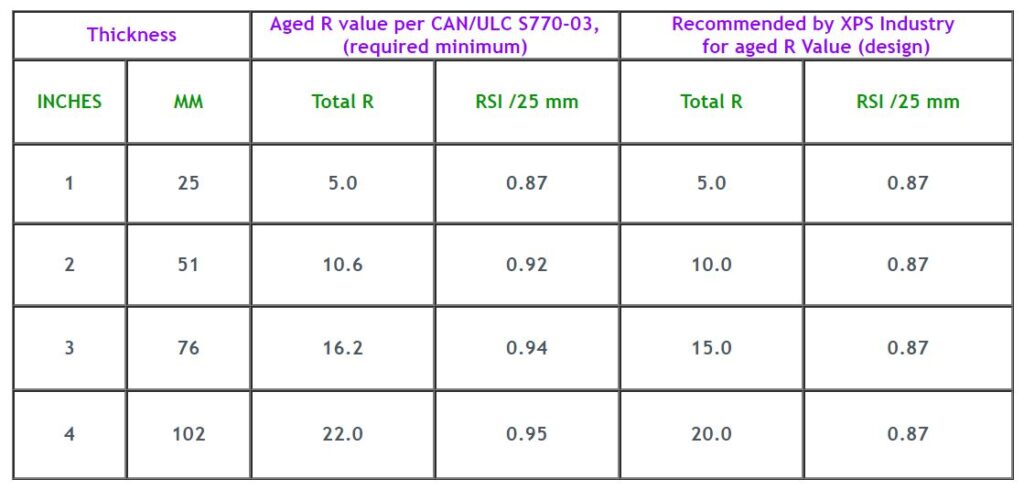
The table below lists the required minimum LTTR values for extruded polystyrene foam insulations when tested according to CAN/ULC S770. Note, the XPS industry recommends using the design aged R-value for XPS insulation thicker than 25 mm (1 inch).