
From the ground up, XPS is very suitable for use.
XPS is often used in foundations because of its high, stable, long-term R-value of 5 per inch and its excellent water-resistance properties. It is also unaffected by common soil acids, mildew and fungus growth, decay or corrosion — making it ideal for long-term durability.
Extruded polystyrene foam (XPS) insulation is most commonly used below-grade in poured concrete, or concrete block foundation systems. Foundations play an important role in keeping a building comfortable, moisture-resistant, and structurally sound.
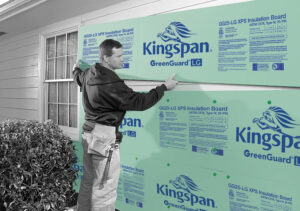
Learn how XPS can help.
Insulation that comes in contact with the soil can be subjected to severe conditions, including long-term exposure to water, high soil humidity, and freeze thaw action. These environmental factors can diminish an insulation’s effectiveness. Therefore, insulation in contact with the ground should be resistant to the action of soil and water such that its insulating properties are not diminished due to this exposure. XPS insulation is ideal for below-grade applications due to its high moisture resistance and long-term insulating performance. In “slab-on-grade” applications, shown below, XPS boards are applied vertically to the inside of the foundation wall. Additionally, XPS can be used to insulate beneath the floor slab.
Freezing has little or no harmful effect on insulation that remains dry, such as XPS. Similarly, insulation that does not absorb moisture from the surroundings will perform well. Conversely, insulation that gets wet does not fare as well. This is an important consideration when specifying an insulating material in areas where freeze-thaw cycles are common. Weather data demonstrate that many locations in North America will experience several hundred freeze thaw cycles over a 10 to 20 year period. Independent studies demonstrate that only XPS insulation is suitable for use in wet, below grade environments where freeze-thaw cycles are common.
There are several advantages to insulating the exterior surface of foundation walls. The block or concrete wall insulated on the exterior surface is protected from large temperature differences and so will not act as a thermal bridge. Block walls insulated on the exterior undergo less air convection in block cavities. At nearly room temperature, the basement walls act as a heat reservoir, buffering interior temperature fluctuations. In some instances, adfreezing forces are prevented from acting directly on the basement wall.
In slab-on-grade applications, XPS boards are applied vertically to the inside of the foundation wall. Additionally, XPS can be used to insulate beneath the floor slab.
XPS insulation is available with varying degrees of compressive resistance typically between 25 psi and 100 psi. The higher compressive strength insulation should be considered in applications subjected to high loading, i.e., mechanical equipment, etc. XPS is durable and versatile, thus it stands up to the rigors of job-site handling and is available in a variety of sizes. XPS insulation for below grade applications is typically provided in standard 2’ or 4’ widths by 8’ lengths and in thicknesses ranging from 1” to 4”. XPS insulation is easily cut on the jobsite to needed sizes by scoring with any common knife and snapping the insulation board.