
How Come EPS is Weaker than XPS of Same Density?
Although the density of Rigid Cellular Polystyrene (RCPS) foam boards may not be of much relevance in building enclosure design, it is noteworthy that material’s strength correlates well with density. There are two observations worth noting:
- Compressive strength and flexural strength generally correlate with density.
- For a given density, XPS types are stronger than EPS types.
For example, XPS Type V and EPS Type XV both must test to a minimal density of 3.0 lb/ft3, but the compressive strength of the EPS type is 40% less than that of the XPS type.
How could two foam boards of the same material with the same density have such different strengths? One possible answer may involve the porosity, which can be subdivided into closed porosity and open porosity.
Porosity is defined as 1 minus the ratio of the density of the foam and the density of the solid: [1 – (ρ/ρsolid)]. According to the National Institute of Standards and Technology [1], the density of solid polystyrene (not insulation) is 1060 kg/m3, which is slightly denser than water. (Of course, solid polystyrene has zero porosity.) In comparison, the density of polystyrene foam insulation boards ranges between 12 and 48 kg/m3. Hence, the total porosity of these types of insulation boards ranges between 0.99% (least dense) and 0.95% (most dense).
Table 1 shows the density and calculated total porosity of various types of RCPS along with the compressive strengths as given in ASTM C578 Table 1. As density increases, the porosity decreases; however, that does not explain the strength differences between EPS types and XPS types of similar porosity.
Table 1. Calculated total porosity of “XPS types” and “EPS types” of rigid, cellular polystyrene insulation based on ASTM C578 minimum density values.
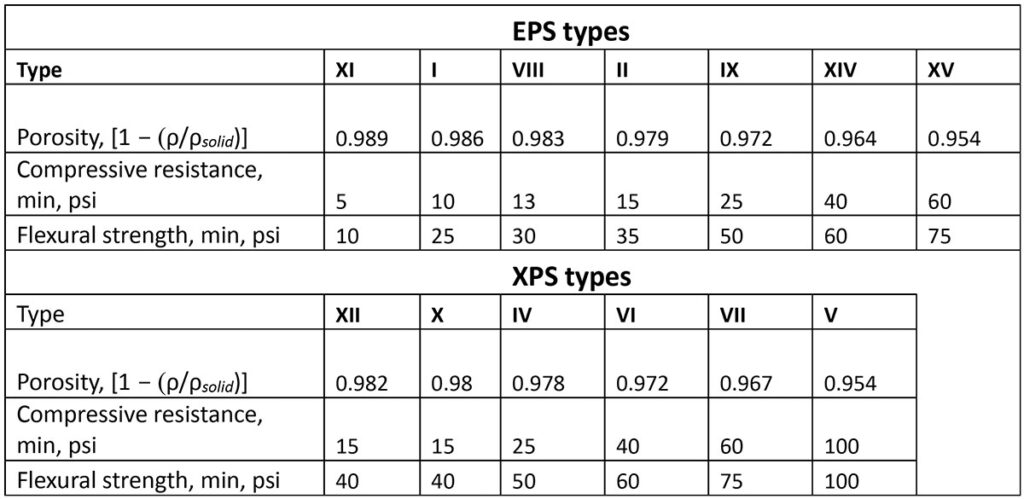
Note: EPS = expanded polystyrene; XPS = extruded polystyrene. 1 psi = 6.895 kPa. ρ = density of foam; ρsolid = density of solid.
Total porosity is the sum of closed porosity and open porosity. Open porosity can be measured by the gas adsorption method: the more gas adsorbed, the greater the open porosity. Open porosity also explains the greater water absorption and permeability of EPS types compared with XPS types of the same density. Most of the porosity of XPS types is closed porosity. In contrast, when the resin beads in EPS are expanded into a closed mold, the channels between the beads provide a substantial proportion of open porosity. Thus, although the cell-wall thicknesses may be similar in EPS and XPS samples of similar density, the EPS sample would have a greater proportion of open porosity (Fig. 1).
The open porosity of the EPS bulk matrix has a deleterious effect on strength and explains why EPS foam board absorbs more water than XPS foam does. Porosity is not the only factor underlying strength. Foam structure on the scale of the cells also is a factor. Mechanical strength is believed to come from polystyrene struts, which offer greater strength than the cell windows. A detailed discussion of how struts can strengthen RCPS is beyond the scope of this article. Interested readers are referred to the technical literature on this topic [2]. What is important to note here is that the strength of foam board is important for many applications of RCPS, and manufacturers are continually seeking to improve this property (Fig. 2).
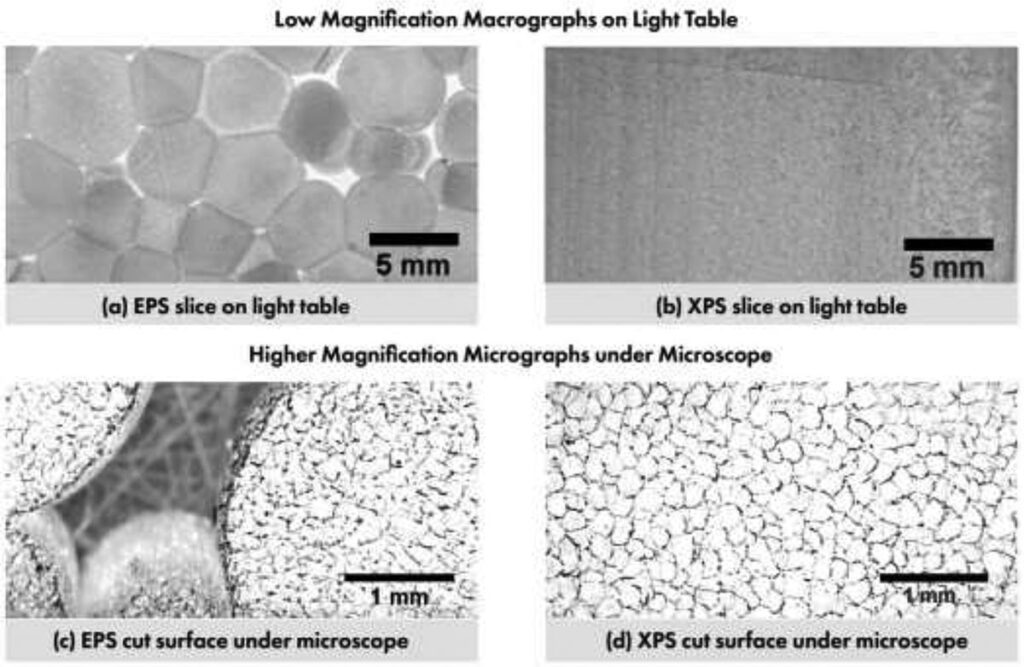
Figure 1. EPS foam illustration has considerable open porosity compared with XPS foam insulation. Note: EPS = expanded polystyrene; XPS = extruded polystyrene.

Figure 2. Aerial view of U.S. Coast Guard Headquarters. XPS insulation must resist compressive loads from the weight of vegetative or “green” roofs. Note: The appearance of U.S. Department of Defense (DoD) visual information does not imply or constitute DoD endorsement. EPS = expanded polystyrene; XPS = extruded polystyrene.
References
1. National Institute for Standards and Technology. n.d. “Composition of Polystyrene.” Accessed October 24, 2023. View Here
2. Gibson, L. J., and M. F. Ashby. 1997. Cellular Solids: Structure and Properties. 2nd ed. Cambridge, UK: Cambridge University Press.