
How XPS Insulation Minimizes Moisture Absorption
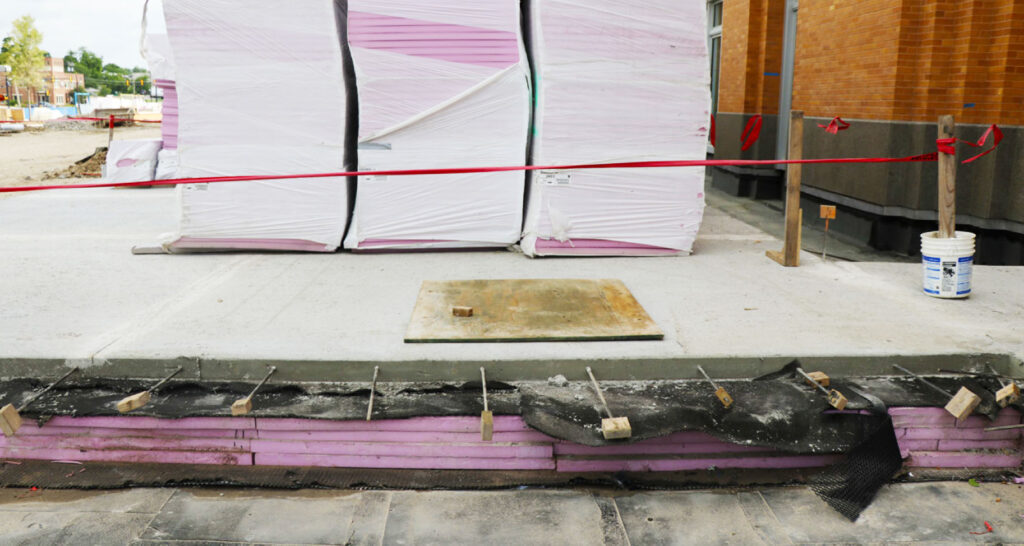
Figure 1 — XPS insulation used with a split slab configuration as part of a Protected Membrane Roof Assembly on Dickies Arena in Fort Worth, Texas. Note how the roof covering is protected by the insulation. Photograph taken during construction, courtesy of Owens Corning.
A key aspect of a Protected Membrane Roof Assembly (PMRA) design is the specification of the insulation boards. Since the earliest use of protected membranes, dating back to the 1950s, it was recognized that extruded polystyrene (XPS) is uniquely well suited for this application.
In a PMRA, the roof covering is protected by the insulation boards and not vice versa; hence, the insulation boards are exposed to the harsh elements of Mother Nature. See Figure 1. That includes heat and cold as well as moisture. The insulation does not serve as a water barrier, but it does need to tolerate water well without deterioration. The insulation may become wet. Water might pond above the roof covering and it might not dry out quickly. Evaporation may be inhibited by the insulation blocking sunlight and thereby lowering the temperature of the roof covering.
These factors place an unusual requirement on the insulation. As many decades of experience have demonstrated, XPS is a uniquely well-suited insulation for PMRA applications.
Proven Moisture Resistance
In the half-century or more since PMRAs were first developed, the extraordinary moisture resistance of XPS has been well documented. XPS is a hydrophobic material. Liquid water beads up and runs off its surface. A white paper from the Extruded Polystyrene Association (XPSA) examines the effects of long-term moisture exposure on the thermal performance of polystyrene insulation in below grade applications [1]. XPS insulation board is found to be more resistant to moisture penetration and related freeze-thaw damage compared to other insulation materials, especially in the long-term, that is, on the time scale of decades [2].
Not surprisingly, the reason for the great success of XPS in PMRA is the same continuous closed cell microstructure that makes it the first choice for below grade applications. The difference between XPS and EPS moisture absorption mechanisms are described in detail in an article in IIBEC Interface [3] as well as an XPS white paper [4]. See Figure 2.
Climate Zones
An important specification of interest for the roof’s design would be determination of the total R-Value required for the climate zone. Total R-Value dictates the thickness of XPS. For more on climate zones, see ASHRAE 90.1 [5] and IECC Climate Zone Maps [6].
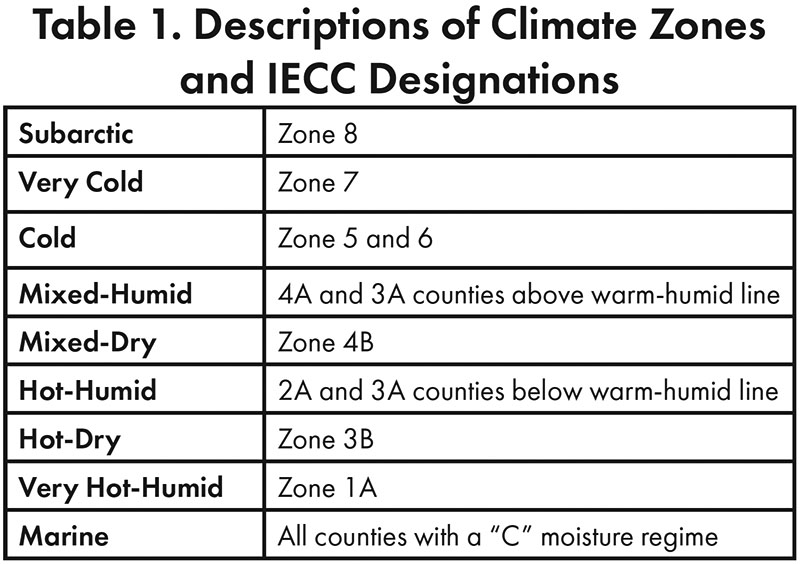
Key: A = Moist, B = Dry, C = Marine. Absence of moisture designation means moisture regime is irrelevant. Among other things, Climate Zones are used to determine insulation requirements, according to ASHRAE 40.1 and IECC.
Drainage Matters
The overall thermal resistance of the PMRA is improved with effective drainage. Ponded water between the insulation and the membrane for long time periods could contribute to moisture absorption, which even for XPS would require R-value adjustments. For this reason and others, drainage systems are essential in most designs of PMRAs even when using XPS insulation. A PMRA typically allows for drainage between the roof covering and the XPS insulation board. A drainage gap can be accomplished with a perforated or dimpled mat made of polyethylene, rubber or a composite material; or the XPS itself could contain channels, slots or kerfs to aid in drainage.
Other insulation types that have greater moisture absorption than XPS claim that temporary exposure to moisture can be offset with drainage and drying. In other words, the rate of drying exceeds the rate of wetting. But this doesn’t account for ponding around drains, or the overall reduced thermal performance during moisture exposure events. Ice formation within insulation causes a drastic reduction in thermal performance [7].
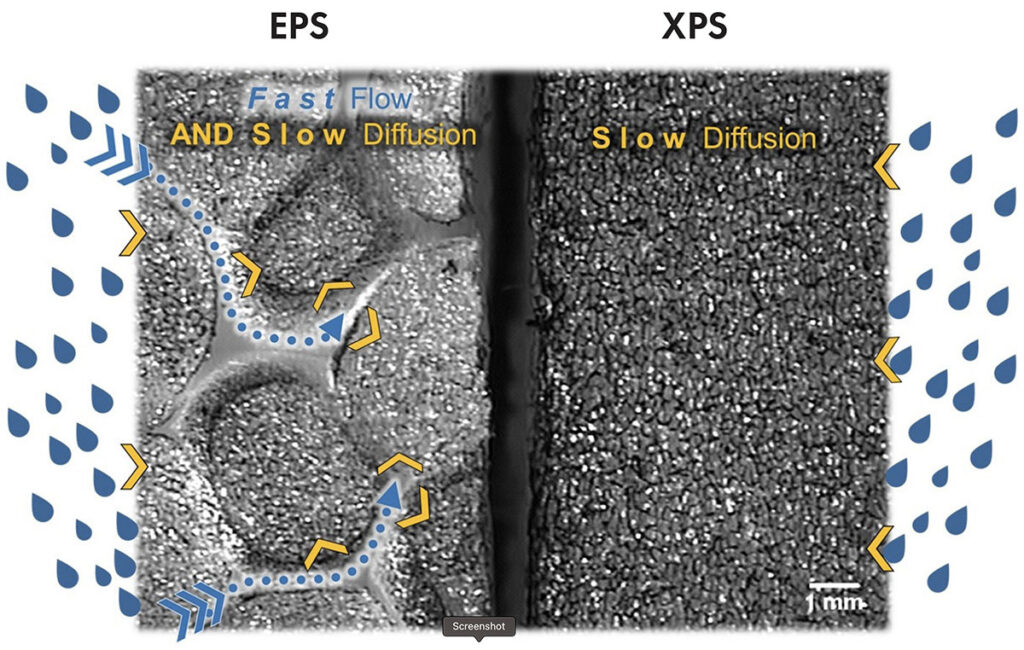
Figure 2 — This diagram shows the differences between moisture transportation in EPS foam (left) and XPS foam (right). The bead structure of EPS facilitates liquid water absorption into the EPS foam. Because of the homogenous cell structure, XPS foam performs better in applications where moisture exposure is inevitable, such as in PMRAs.
Best Practices
There are many considerations in the design of PMRA: structural performance, wind uplift resistance, means of egress for occupiable roofs, and other factors. Fortunately, much knowledge and experience has accumulated in recent years and more and more contractors and building materials suppliers are knowledgeable of standards and best practices.
Published guidance has been developed about PMRA and is still evolving. The interested architect or designer is encouraged to contact one or more of the XPS manufacturers for recommendations on designing a PMRA that will provide maximum durability and performance.
References
1. Rob Brooks, et al. “Extruded Polystyrene Delivers Higher R-Values than Expanded Polystyrene in Below-Grade Applications,” XPS Insulation Performance, Below Grade Series, ID: IP-BG-01. View Here
2. John Woestman, “XPS Delivers High R-Values in Below-grade Applications,” The Construction Specifier, August 2020. View Here
3. John Woestman, “Moisture Absorption in Polystyrene Insulation: Effects on In-Service Design R-Values,” IIBEC Interface, November 2020. View Here
4. Rob Brooks, et al. “Effects of Moisture Absorption Mechanisms on In-Service Design R-Values of Polystyrene Insulation: XPS and EPS Behave Differently in Moist Below-Grade Applications,” XPS Insulation Performance, Below Grade Series, ID: IP-BG-02. View Here
5. ASHRAE STANDARD 90.1-2019 Energy Standard for Buildings Except Low-Rise Residential Buildings. View Here
6. International Code Council. “International Energy Conservation Code.” [Climate Zones] View Here
7. V. Woodcraft, G. K. LeBlanc, M. Spinu, and T. Weston, “Dynamics and Impact of Vapor-Driven Moisture on Properties of Insulating Foams,” in “Performance, Properties, and Resiliency of Thermal Insulations”, ed. D. Fisler and M. Pazera (West Conshohocken, PA: ASTM International, 2021), 40–59. View Here