
Maximum Allowed Water Absorption is Key to ASTM C578
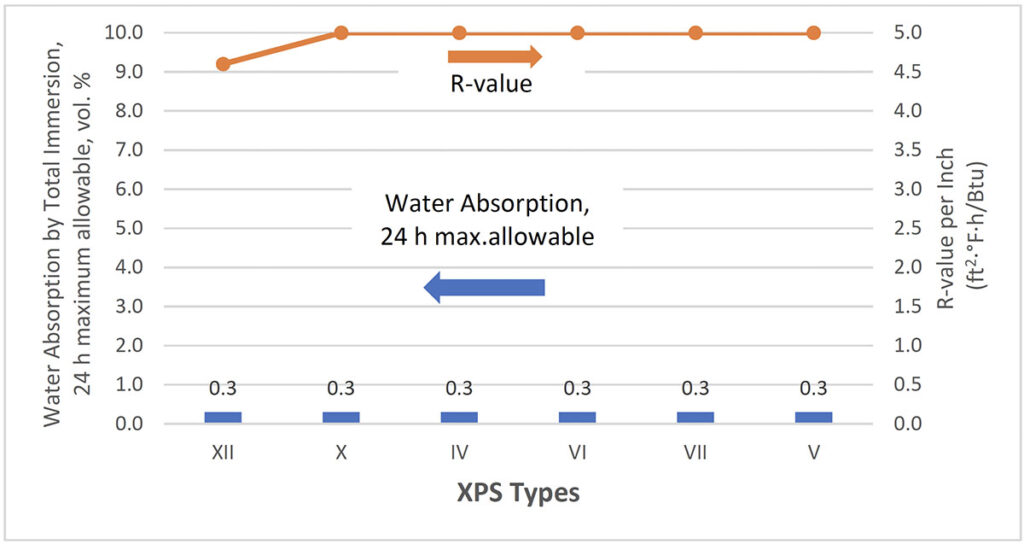
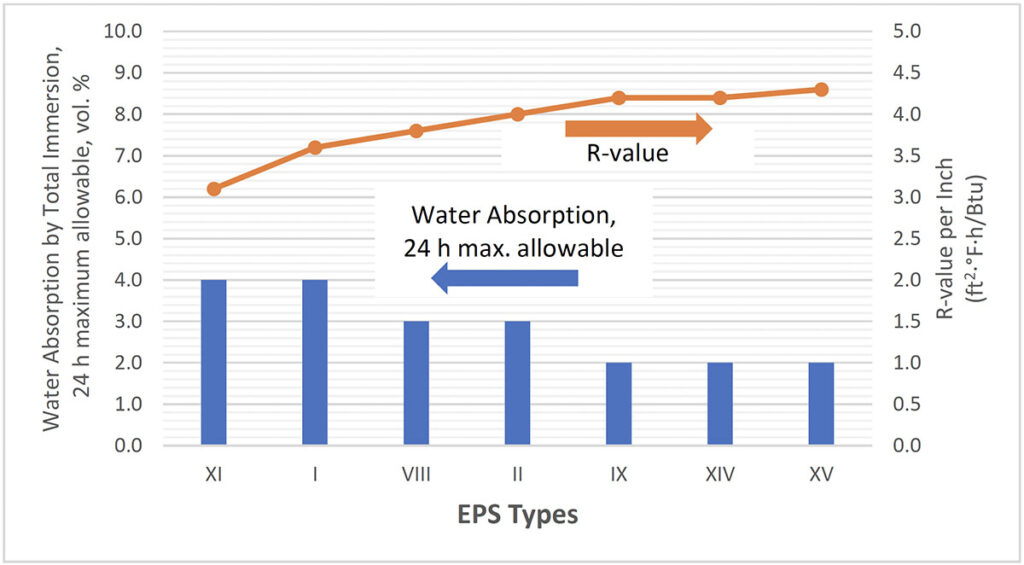
Figure 1. R-value per inch increases as water absorption decreases. The high R-values for XPS could be attributed in part to its low values of water absorption. Water absorption is measured in percentage by volume. Note: EPS = expanded polystyrene; XPS = extruded polystyrene.
Values are from ASTM C578 [1]
The most startling numbers in ASTM C578 Table 1 are found in the row on water absorption [1]. These numbers represent the maximum water absorption allowed to meet the standard for each of the RCPS types. There is no question that EPS absorbs much more water than XPS, specifically in short-term testing by total immersion. Maximum water absorption values of 2%, 3%, or even 4% by volume are seen for EPS types. In general, for EPS types, as density increases, the maximum R-value is reduced but it does not drop below 2% by volume (Fig. 1).
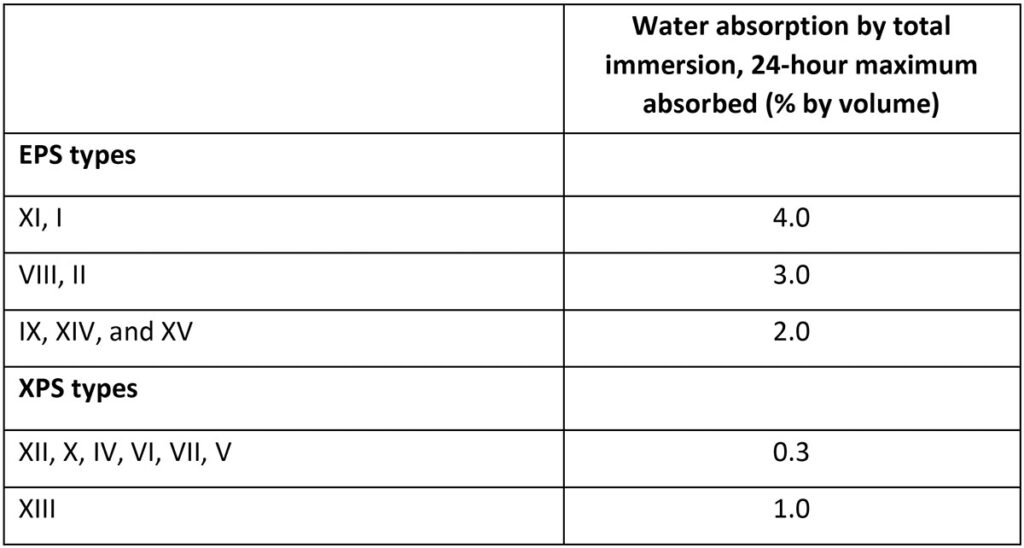
Water weighs 1000 kg/m3. When 2% of the volume of a cubic meter of Type XV foam is occupied by water, 20 kg of water are added to the 48 kg of foam. Values for water absorption per ASTM C272, Standard Test Method for Water Absorption of Core Materials for Sandwich Constructions [2] for EPS Types XI and I (up to 4% by volume), EPS Types VIII and II (3%) and EPS Types IX, IV, and XV (2%) are in sharp contrast to the maximum water absorption for XPS Types XII, X, IV, VI, VII, and V (maximum 0.3% by volume). In other words, depending on the specific type, EPS can absorb 7 to 10 times as much water as XPS and still meet the ASTM C578 product standard. See Table 1.
Table 1. Water absorption for various “EPS types” and “XPS types” of rigid, cellular polystyrene insulation.
The water absorption rates for short-term testing represent a major difference between EPS and XPS types of RCPS foam. ASTM C578 requires manufacturers to meet the water absorption limits for relatively short periods of immersion. Additionally, ASTM C578 mentions in the Appendix X1.4, “Water Absorption,” that “this characteristic may have significance when this specification is used to purchase material for end-uses requiring extended exposure to water.” The appendix is considered “nonmandatory” information, and ASTM C578 does not quantify the effects of this water absorption on the thermal performance of the materials. Designers are left to their own resources.
The reason for this disparity in water absorption rates has to do with the discontinuous structure of EPS foam boards, which results in significant open porosity (as described in the previous section). The capillary pathways allow water to enter the EPS types throughout the bulk of the material, depending on the capillary sizes. Smaller bead sizes—such as those used in food-grade EPS—result in smaller and less-permeable capillaries but also limit the density reduction. On the contrary, relatively little water enters the bulk of the XPS samples because the high proportion of closed-cell porosity inhibits the absorption of water. XPS insulation has a smooth microstructure that is not interrupted by the millimeter-scale “bead structure” prevalent in EPS types.
The consequences of water absorption can be substantial depending on the application. Its water absorption rate is one of the main reasons why EPS is unsuitable for protected membrane roofing assemblies [3]. It also explains why XPS is preferred in below-grade applications. Also, XPS is preferred over EPS for habitable basements, where polystyrene insulation is commonly applied exterior to the basement walls and floor slabs (and thus is often in contact with groundwater or moist soil) [4].
The mechanisms of water absorption are reviewed in considerable detail in Brooks et al. [5]. See also Pakkala and Lahdensivu [6].
Myths about Testing for Water Absorption
Aside from the water absorption mechanisms, which in general are not disputed, several myths and misinterpretations have developed concerning water absorption testing. Most experts readily acknowledge that R-values of RCPS foam boards drop as water is absorbed. This is based on simple physics. The thermal conductivity of water or ice is much greater than the thermal conductivity of air or blowing agents. Performance has been simulated using computer models [7,8]. Nonetheless, the prediction of water absorption depends on the application, the climate zone, and other factors.
Some have argued that water absorption does not really matter because the insulation quickly dries out. This is untrue in many cases, especially for below-grade applications.5 It is also argued that there is an upper limit to the amount of water that can be absorbed. This is also not true, according to findings reported by Cai et al. [9,10].
The crux of the misunderstandings is the conflation of the ASTM C578 standard with performance expectations. ASTM C578 does not dictate the thickness of insulation required to achieve long-term design R-values. That is based on engineering judgment using various thickness-correction guidelines.
Specifiers must keep in mind that the short-term testing for moisture absorption used in ASTM C578 does not predict how moisture absorption affects performance in different applications. There is a heavy energy-waste penalty due to reduced R-value when insulation is incorrectly used in wet environments such as building foundations, protected membrane roofing assemblies, infrastructure in cold regions, and other below-grade applications. It is up to the specifier or consultant to account for the consequences of material choices in any given application.
ASTM C578 only gives basic properties of the various types of EPS and XPS at the time of manufacture. In the final analysis, the building enclosure consultant, architect, engineer, or specifier must exercise “engineering judgment” in the design of insulation systems suitable for a particular application and environment. Thermal stability, moisture control, thickness factor, long-term R-values and so on are all relevant to the design of below-grade structures.
References
1. ASTM International. 2023. Standard Specification for Rigid, Cellular Polystyrene Thermal Insulation. ASTM C578-23. West Conshohocken, PA: ASTM International.
2. ASTM International. 2018. Standard Test Method for Water Absorption of Core Materials for Sandwich Constructions. ASTM C272/C272M-18. West Conshohocken, PA: ASTM International.
3. Brooks, R., T. Coppock, M. Dillon, V. Woodcraft, and J. Woestman. 2022. “Extruded Polystyrene in Protected Membrane Roof Assemblies.” Extruded Polystyrene Foam Association (XPSA). View Here
4. Brooks, R., T. Coppock, M. Dillon, M. Guo, V. Woodcraft, and J. Woestman. 2022. “The Role of Insulation for Habitable Basements,” XPSA. View Here
5. Brooks, R., T. Coppock, L. Frazier, J. Smith, J. Woestman, and V. A. Woodcraft. 2021. “Effects of Moisture Absorption Mechanisms on In-Service Design R-Values of Polystyrene Insulation.” XPSA. View Here
6. Pakkala, T. A., and J. Lahdensivu. 2014. “Long-Term Water Absorption Tests for Frost Insulation Materials Taking into Account Frost Attack.” Case Studies in Construction Materials 1: 40-45. View Here
7. Cai, S., H. Guo, B. Zhang, G. Xu, K. Li, and L. Xia. 2020. “Multi-scale Simulation Study on the Hygrothermal Behavior of Closed-Cell Thermal Insulation.” Energy 196: 117142. View Here
8. Woodcraft, V., G. K. LeBlanc, M. Spinu, and T. Weston. 2021. “Dynamics and Impact of Vapor-Driven Moisture on Properties of Insulating Foams.” In Performance, Properties, and Resiliency of Thermal Insulations, D. Fisler and M. Pazera, eds. ASTM STP1629-EB. West Conshohocken, PA: ASTM International. View Here
9. Cai, S., B. Zhang, and L. Cremaschi. 2018. “Moisture Behavior of Polystyrene: Insulation in Below-Grade Application.” Energy and Buildings 159: 24-38. View Here
10. Cai, S., B. Zhang, and L. Cremaschi. 2017. “Review of Moisture Behavior and Thermal Performance of Polystyrene Insulation in Building Applications.” Building and Environment 123: 50-65. View Here